
Aruba is around 20 miles long and 6 miles wide, so getting your bearings as to where everything is on the island is surprisingly easy. Most of the island’s beaches, resorts, and restaurants sit along the calm seas of the western coast and are clustered into distinct areas.
Our team of local experts has put together this guide to help you learn about the main zones, where each one is, and what they have to offer, to help you get the most out of your trip to Aruba. This way, you’ll know where you want to go and what you want to do before you even get to the island.
Aruba is an incredibly easy island to navigate and for visitors to understand. The seas along the western coast are calm and comfortable for swimming, and the seas along the eastern coast are rough and windswept, so most of the major hotels and resorts are concentrated along the western coast. Palm Beach is generally known as the high-rise area, and Eagle Beach and Druif as the low-rise area.
The eastern side of the island isn’t completely empty, though. There sits the famous Arikok National Park, which covers 34 square kilometers, or around a fifth of the island’s land. This is a gorgeous spot that nature-loving visitors simply must see.
Getting around is simple. Drive times vary with where you start, where you’re headed, and traffic, so choosing where you want to stay is more about the convenience of your surroundings than about what you’ll be able to reach during your stay.
Here’s a fun local detail: Aruba’s trade winds are so consistent that our divi-divi trees famously lean in the same direction, always pointing southwest. People sometimes joke that if a tourist gets lost, they should follow the divi-divi trees, because they point toward the hotel areas.
Aruba isn’t only hotels and resorts anymore, either. Timeshares are a big part of the market, with about 3,500 timeshare units across roughly 16 resorts, and vacation rentals, condos, and villas have become increasingly significant too. The Aruba Tourism Authority estimates there are 5,500 to 6,000 short-term vacation rental units on the island, and about a third of visitors stay in a vacation home. Visitors are staying not only around Palm Beach and Eagle Beach, but in areas such as Noord, Bakval, Malmok, Oranjestad, Pos Chiquito, and Savaneta, and where you stay also changes how walkable your days are and whether you need a car.
Aruba by area
Almost everything sits along the calm west coast. Drive times below are from Palm Beach in normal traffic.
Quiet coves, shore snorkeling at Boca Catalina, Arashi sunsets, and the California Lighthouse.
High-rise resorts, water sports, and the densest dining strip, including Arawak Garden.
Low-rise hotels, fofoti trees, and more space on one of the world's top-rated beaches.
The capital and cruise terminal, with Dutch Caribbean streets and a free downtown tram.
Aruba's original capital: a fishing village with waterfront seafood and Mangel Halto kayaking.
The Mural District, Charlie's Bar, and Baby Beach's sheltered lagoon a few minutes away.
About a fifth of the island: caves, Boca Prins, and the Natural Pool (Jeep only).
Just south of Oranjestad, so every resort area is an easy transfer.
Know where you're staying? Find dinner nearby.
Map is illustrative and not to scale. Drive times are approximate and vary with traffic and cruise days.
Palm Beach is one of the busiest and most popular areas on the island. The wide stretch of white sand is backed by the island’s deepest concentration of large, towering resorts, restaurants, and bars. Behind the beachfront resorts, the High-Rise Strip along J.E. Irausquin Boulevard puts plenty of hot spots within easy walking distance. The ever-popular Arawak Garden is part of this dining hub, boasting a number of restaurants clustered around an open-air courtyard, making it an easy place to wander over for dinner without the need to plan transportation.
Head north, and the resort strip of Palm Beach gradually gives way to the Hadicurari stretch, around the Marriott and Fisherman’s Huts. This area begins to feel a little more open than the crowded hustle and bustle of Palm Beach’s center, and is a hotspot for windsurfing and kitesurfing, with plenty of restaurants and great spots for enjoying the sunset still close by.
If you plan on heading out of the Palm Beach neighborhood, distances between other popular destination areas are relatively short. Eagle Beach is around a 5 to 10 minute drive away, Oranjestad is about 10 to 15 minutes away, and Queen Beatrix International Airport is around 20 minutes away, depending on traffic, of course. Palm Beach is especially well suited to visitors looking for a full-service resort with everything they could want right on their doorstep. There are plenty of places to eat and drink, thrilling watersports available nearby, and the freedom to head out anywhere you like on an evening without the hassle of having to call for a taxi.
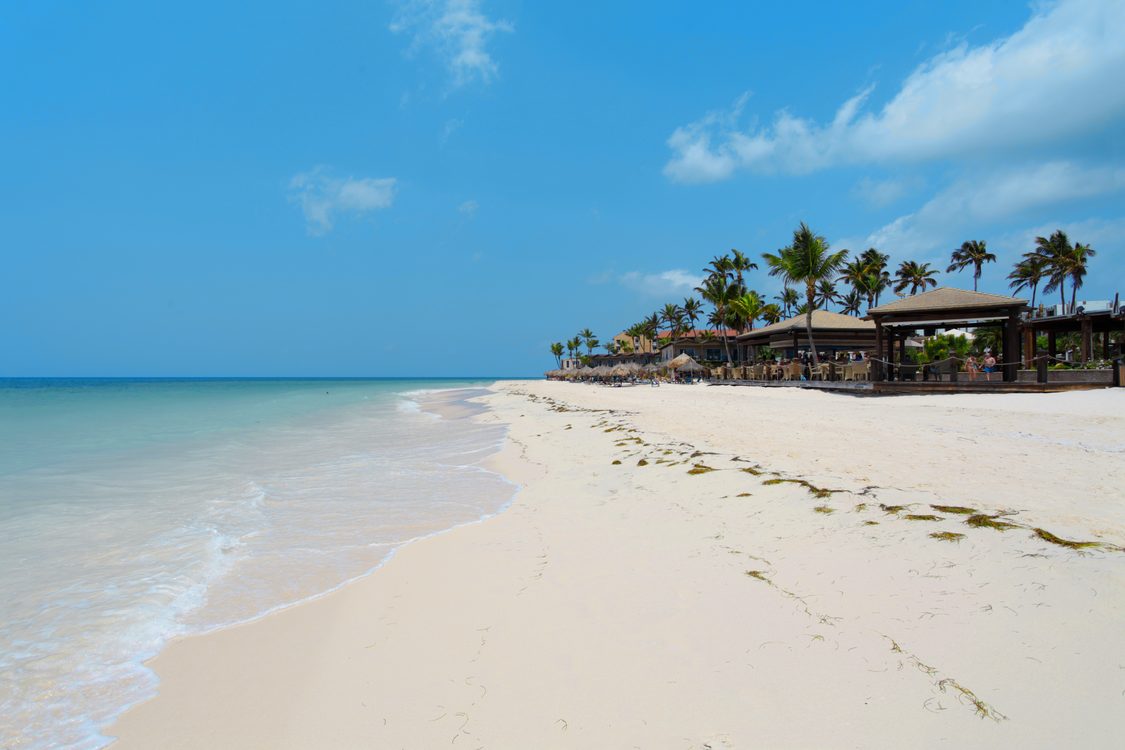
A few minutes' drive south of Palm Beach is the low-rise corridor along Eagle Beach. With smaller-scale hotels and resorts, fewer crowds, and more space on the beach, it's a great alternative for those looking to be close to the waterfront without all the hustle and bustle. Eagle Beach is home to some of Aruba’s iconic fofoti trees and is considered to be one of the best beaches in the world.
Eagle Beach runs south towards the Druif Beach area, where you can find:
While the area around Eagle Beach is quieter and more laid-back, it still has a handful of good walkable restaurants, along with hotel restaurants and some very nice, swanky pool bars. Toward Druif, beachside favorites such as Matthew’s at Casa del Mar and Kokoa at Aruba Beach Club sit close to the sand. Palm Beach has a dense concentration of restaurants, nightlife, and activity, so for the widest choice you may take a short drive or taxi ride there. If you have your heart set on a particular spot, it’s a good idea to plan ahead and make reservations so you don’t miss out.
Aruba’s cruise terminal sits right on the edge of Oranjestad’s downtown, so if you’re coming by ship, you’ll be able to step straight off and into the heart of the capital. Head a few streets inland, and you’ll find an astonishing amount of history. Wilhelminastraat, named after Queen Wilhelmina of the Netherlands, is lined with the old merchant homes and commercial buildings of the town’s historic commercial district, some of them more than a century old, and several are restaurants today. Que Pasa is a natural example, set in a former merchant’s townhome that still has its original staircase, wood floors, and ceiling.
Caya Betico Croes is the main shopping street in this part of town. It’s named after Betico Croes, the political leader remembered as the father of Aruba’s Status Aparte, while the waterfront is curated more specifically for cruise passengers and international shopping. For a taste of the island’s drinking culture, downtown is also home to Pepe Margo, described as Aruba’s first true rum distillery, in a century-old house. Across the island, traditional rum shops have been neighborhood social hubs for more than 100 years.
Because of the small size of the island, Oranjestad is not a huge capital. You can comfortably explore the central areas without the need for a car. The free downtown trolley runs Monday to Saturday, 10:00 a.m. to 4:30 p.m., looping between the cruise terminal and the Main Street shopping areas. The full route operates until 1:30 p.m., with a shorter route afterward. If you’re hoping to explore more of the island, though, you’ll need a taxi, bus, or car to reach other areas, such as Palm Beach or Eagle Beach.
Downtown has a noticeable cruise-day rhythm. When ships are in port, the streets around the terminal, main shopping areas, and the waterfront are a lot busier, so check the official Aruba Ports Authority cruise schedule when planning your Oranjestad day.
Back up on the north end of the island, above the area of Palm Beach, you’ll notice that Aruba becomes noticeably quieter and less developed. The Malmok coastlines mix rocky shores with small, protected coves. If you plan on immersing yourself in nature, be sure to pay a visit to this area and enjoy some shore snorkeling in Boca Catalina. The sheltered, clear waters here make it one of the island’s most reliable spots for snorkeling directly from the shore. To see it from the water, Jolly Pirates sails from Hadicurari Pier in the MooMba Beach area, and its afternoon snorkel cruise stops at Malmok Reef, Boca Catalina, and the WWII Antilla shipwreck.
A little further north of Malmok is Arashi. This area is worthy of being treated as a beach and sunset stop in its own right. It boasts a white stretch of sand, a beach bar, and an open west-facing view that makes it a stunning spot later in the day for viewing the sunsets over the water. Just beyond Arashi sits the California Lighthouse, where you can enjoy panoramic views across the northern tip of Aruba. If you plan on heading out here for an evening of stunning viewpoints and true escapism, fear not, you won’t need to head all the way back to a major area for dinner. Instead, you can stop by the stunning Faro Blanco Restaurant perched on the nearby hillside.
While there are far fewer restaurants, activities, and services than in popular areas like Oranjestad or Palm Beach, this end of the island is still more than worth seeing if you have the time. Rent a car for the day to spend some time exploring Malmok, Boca Catalina, Arashi, and the California Lighthouse, or join Kukoo Kunuku’s Day Tripping tour, which includes the lighthouse among its stops.
Once Aruba’s capital until 1797, Savaneta now feels worlds away from the bustling resort strip. This quiet fishing community sitting on the island’s southern coast has small-scale accommodation, waterfront seafood spots, and a much more local, laid-back feel than the popular hot spots.
It’s definitely worth the visit if you’re interested in getting a more local experience of the island, and it makes a great day trip no matter where you choose to stay on the island. It is located a relatively short drive from major areas, and takes only 30 to 35 minutes in the car from Palm Beach. While you’re there, be sure to head just north of the village to Mangel Halto, where you can find shallow turquoise waters surrounded by mangroves. It’s the perfect spot for kayaking around the channels in the stunning waters.
San Nicolas is arguably Aruba’s most underrated destination, and there’s a much bigger story here than murals alone. The town grew up around the Lago oil refinery, which opened in 1924 and closed in 1985, drawing workers and families from across the Caribbean and beyond. In its heyday, the town was home to the island’s old commercial center, and its main streets still reflect that history.
Today, local galleries and artists have helped turn the town around. There are now more than 100 murals by local and international artists, independent galleries, and the annual Aruba Art Fair, which held its ninth edition in September 2026 as the finale of Art Week. The Museum of Industry in the historic water tower and the San Nicolas Community Museum tell the town’s story, and Charlie’s Bar & Restaurant, open since 1941, is still a local landmark.
Local food and businesses are part of the draw, too, from Caribbean kitchens to events like the San Nicolas Food Truck Festival, and Kukoo Kunuku’s evening Taste of San Nicolas pairs the murals with local stories and dinner. Significant investment and revitalization are underway downtown, beginning with a renovated bus station area and a new farmers market. Allow around 35 to 40 minutes for the drive from Palm Beach, and save time for Baby Beach, a sheltered lagoon just beyond town that’s ideal for calm, shallow family swims.
Arikok National Park takes up about a fifth of Aruba’s land and covers a large amount of the island’s rugged eastern coast. It has two entrances: San Fuego, open daily from 8:00 a.m. to 3:30 p.m., and Vader Piet, which closes at 3:00 p.m. A Conservation Day Pass costs $22 per adult; children under 17 enter free, and residents receive a local discount.
The park’s caves deserve a proper stop. Fontein Cave is the only one with Arawak drawings on its ceiling, and Quadirikiri Cave has two chambers lit by sunlight coming through holes in the roof. Park rangers at the cave entrances can share the stories behind the rock drawings and formations, and the park staff and guides add so much context for visitors. A standard rental car can reach many of the main sights, including the caves and Boca Prins, but the rough road to the Natural Pool at Conchi requires a 4x4, so book a guided excursion ahead of time if it’s on your list.
Aruba is compact, but drive times depend on where you start, where you’re going, and the time of day, and the hustle and bustle of the strip or busy cruise days can cause delays. We’ve put together a simple table showing how long it should take to get between the island’s iconic areas. These figures should be taken as planning times, ensuring you add a little extra buffer on busy cruise days or at peak times, especially if you’ll be traveling through a busy area.
Drive times
Approximate drive times in normal traffic. Add a buffer on busy cruise days and at peak times.
Swipe sideways to see every area.
| From / to | Airport | Oranjestad | Eagle Beach | Palm Beach | Malmok | Arikok | San Nicolas |
|---|---|---|---|---|---|---|---|
| Airport | Same area | 5–10 min | 10–15 min | 15–20 min | 20–25 min | 30–35 min | 25–30 min |
| Oranjestad | 5–10 min | Same area | 10 min | 10–15 min | 15–20 min | 20–25 min | 30–35 min |
| Eagle Beach | 10–15 min | 10 min | Same area | 5–10 min | 15–20 min | 25–30 min | 35–40 min |
| Palm Beach | 15–20 min | 10–15 min | 5–10 min | Same area | 10–15 min | 30–35 min | 35–40 min |
| Malmok | 20–25 min | 15–20 min | 15–20 min | 10–15 min | Same area | 35–40 min | 40–45 min |
| Arikok | 30–35 min | 20–25 min | 25–30 min | 30–35 min | 35–40 min | Same area | 20–30 min |
| San Nicolas | 25–30 min | 30–35 min | 35–40 min | 35–40 min | 40–45 min | 20–30 min | Same area |
Times vary with your exact starting point, where you're headed within each area, and traffic. Arikok times depend on which entrance or attraction you're visiting.
Queen Beatrix International Airport sits just south of Oranjestad. It is located just a 10-minute drive from downtown and around 20 minutes from Palm Beach in regular traffic conditions. On arrival, you can take a taxi, pick up a rental car, or book a prearranged transfer to your destination.
Because Aruba is such a compact island, airport proximity is rarely a deciding factor in where to stay. The resort areas on the western coast are all close enough to the airport terminals for a straightforward transfer, so choose your base because of the beach, restaurants, and atmosphere you’re looking for, rather than trying to minimize the journey from the airport.
Whether you need a car depends on where you’re staying and what kind of trip you’re hoping to have. Guests staying around the high-rise or low-rise areas can certainly spend days without one, but we’d still encourage you to rent a car for part of your stay or take an island tour so you can see more of Aruba. Kukoo Kunuku’s Day Tripping tour is an easy way to do that, with hotel pickup. It stops at areas such as the California Lighthouse, Alto Vista Chapel, the Casibari rock formations, and the Natural Bridge.
Getting around without a vehicle in most areas is quite easy. The Arubus runs frequently along the hotel strip, with buses every 15 minutes during the day and every 40 minutes in the evening. Coverage and schedules are less convenient outside of the main tourist areas, so if you’re planning on venturing a little further afield, it may be easier to get a taxi. Taxi services in Aruba are also pretty good. This is primarily because they have government-set fares, rather than meters. If you’re visiting Oranjestad, the free-to-ride tram is also a great way of getting around.
Hiring a car is a much more convenient option when you want to spend the majority of your time exploring Aruba well beyond the hotel strip. This is particularly the case if you’re heading to areas like Arikok National Park. A standard rental car should be fine for navigating the park’s main roads, but the North Conservation Zone, including Conchi Natural Pool, requires a Jeep for access along the off-road tracks. If you’re heading to Arikok National Park in a hire car, be sure to check your rental agreement carefully. Standard rental cars are frequently prohibited from using unpaved or rough roads, even when the route may seem accessible.
Where you choose to stay in Aruba truly shapes the days you’ll have on the island. It dictates the majority of activities you’ll enjoy, and also what dining options you’ll have readily available. In some areas, there are dozens of restaurants within easy walking distance, and others have a handful of restaurants scattered around, and not much else nearby. If you’re a foodie, this can make all the difference to what your trip looks like. Here is what the dining scene generally looks like in each of Aruba’s main areas:
Once you have an idea of what area you’re hoping to dine in, be sure to check out the latest specials and events, or join the rewards app to explore more of Aruba’s dining scene for less.
When planning your visit to Aruba, you should start by choosing the area of the island that best fits how you want to spend your vacation. Whether it’s having fun on the waves at Palm Beach, soaking up the sun at the more relaxed-paced Eagle Beach, or exploring the cultural hubs of San Nicolas or Oranjestad, there’s something for everyone.
After choosing where to spend your time, you can then plan your transport around the other things you want to see and do that may be a little further afield. Once your itinerary has taken shape, be sure to check the available vouchers and gift cards for restaurants and experiences you already intend to visit. You can learn more about how our team of local experts is here to help you plan the perfect Aruba getaway and support the local community through our We Care Initiative.
Ready to start exploring? Book a sail and snorkel cruise directly with Jolly Pirates, or book an island tour or food experience with Kukoo Kunuku.
Aruba measures roughly 20 miles long and 6 miles wide, covering about 180 square kilometers. Most hotels and resorts sit on the calm western coast, while Arikok National Park occupies roughly a fifth of the island on the eastern side.
Palm Beach is the high-rise area, with large resorts, restaurants, bars, and water sports, a wide beach, and a lively atmosphere. Eagle Beach is the low-rise area, quieter and more spacious, and consistently ranked among the world’s best beaches. Palm Beach has the most concentration of restaurants, nightlife, and activity, but Eagle Beach still has a handful of walkable restaurants, hotel restaurants, and pool bars.
The drive runs roughly 10 to 15 minutes in normal traffic, though it stretches during peak hotel-strip congestion and on heavy cruise days. Taxis operate on published fixed rates between zones, and Arubus serves the corridor on a regular schedule. Walking the full distance is possible but not practical in midday heat.
Within zones, yes. Palm Beach and downtown Oranjestad are comfortably walkable, Eagle Beach has a handful of walkable restaurants, and the free trolley covers the downtown core. Between zones, the distances are too long, and the roads are not built for pedestrians, so most visitors walk within their area and take a taxi, bus, or rental car everywhere else.
You can spend days without one if you’re staying in the high-rise or low-rise areas, but renting a car for part of your stay or taking an island tour helps you see more of Aruba. A 4x4 is required for Arikok’s North Conservation Zone and the Natural Pool, and standard rental agreements commonly prohibit unpaved roads, so a guided tour is the easiest way to get there.
Cruise ships dock at the terminal in Oranjestad, directly adjacent to downtown. Renaissance Marketplace, Caya Betico Croes shopping, and the historic Wilhelminastraat district are all within walking distance, and the free tram covers the downtown core. Beaches and attractions outside the capital require a taxi or tour transport.
